Sage — Human Centered AI Design
When workflows change hands, the WHY disappears. The WHAT survives. Sage was built to close that gap.
Client
Type
Year
The problem
Workers in enterprise operations spend 20–30% of every shift reconstructing context — not acting on it. Who made this decision? Why? What constraints are still active? The answers live in someone's head, in a Slack thread, in a system no one checks. When workflows change hands, that context evaporates. No existing tool preserves the WHY behind decisions. They capture the WHAT. Sage closes that gap.
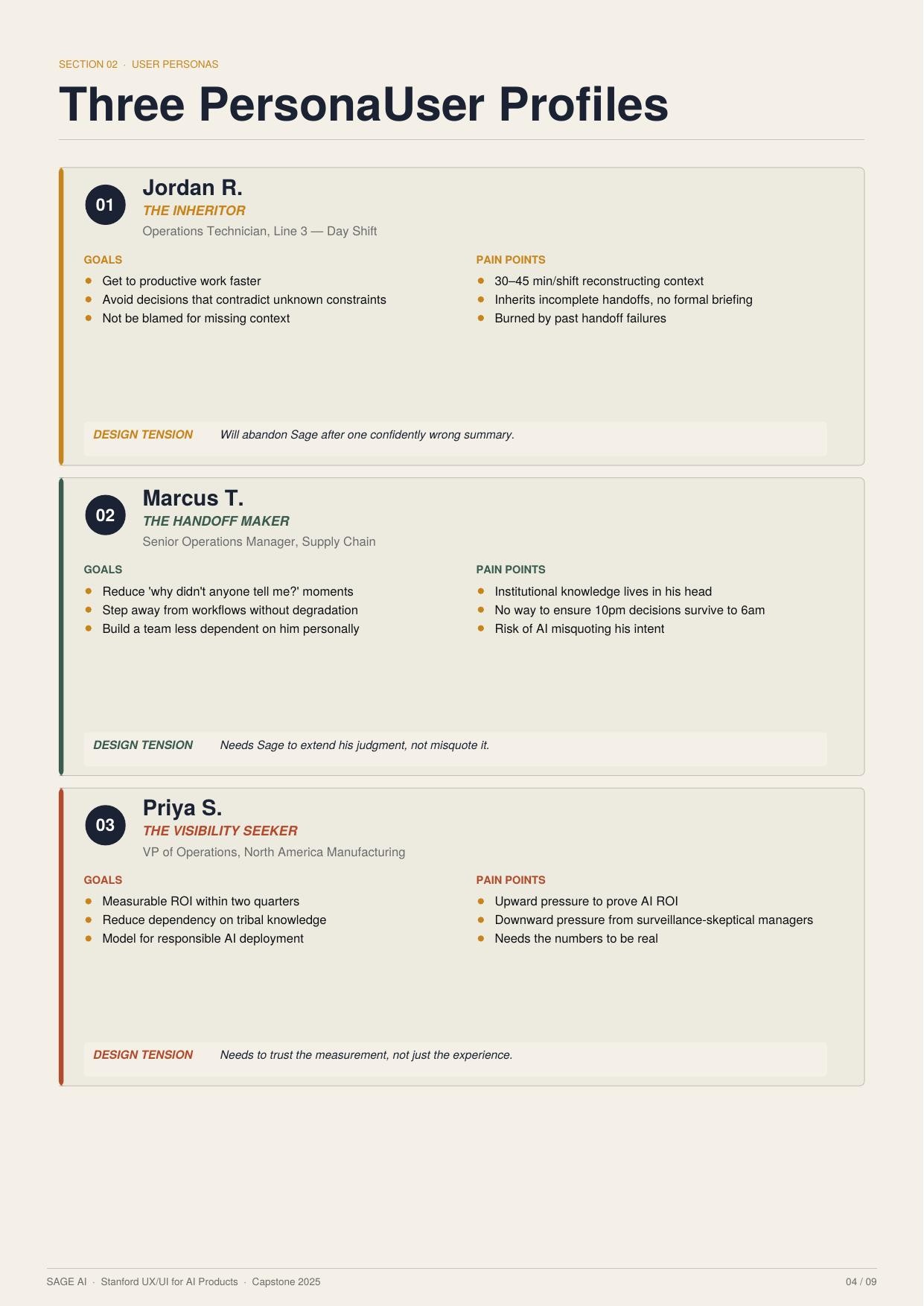
The design
Sage operates as an ambient AI context layer — passively observing ERP, MES, and CRM event streams and surfacing organized, sourced, human-correctable context at the exact moment a worker needs it.
Three mechanisms: Ambient Capture observes actions, not people. Intent Threading maintains the WHY behind every decision, not just the WHAT. Handoff Brief Generation delivers structured situational briefs when workflows change hands — always ending with "Open Items Requiring Your Judgment." That section is never empty.

The governing principle
The agent never recommends. Never suggests. Never fills a blank decision field — even partially. Every claim is attributed to a source, a person, a timestamp. Low confidence is flagged before uncertain content is surfaced. When it cannot produce high-confidence output, it does not guess.
The constraint that shaped everything: the boundary between where AI stops and human judgment begins isn't a limitation. It's the whole product.

What I learned
The hardest design problem in AI isn't what the system does. It's what it refuses to do — and how it communicates that refusal without losing the user's trust. Restraint is a design material. Every feature we excluded was an architectural decision, not a gap.
No decision recommendations. No autonomous escalation. No individual performance profiling. No speculative inference.
"The goal is not for users to trust the AI. It is for users to trust themselves more, because the AI is present."
